
A story in six words
Wam, bam, no, thank you ma’am – a short story about the first time I pitched a stranger my service. All the no’s I had received prior to this point were really soft maybes, too busys, and I'll think about its. This time, I was met with a super direct no, an incredible shutdown, a resounding “No, I will not be doing that." To me, it was like a folding chair to the face. I was used to people (aka friends) being curious about what I was up to, what I had to offer. This stranger wasn’t curious at all.
Just like that, I stopped selling that service. No one rejection should stop a service in its tracks. Hindsight is 20-20 though, huh?

But how do budding business owners make the jump from confident business on paper to confident business in the wild?
That is exactly the question that Jazmin Anderson, Director of Equitable Economic Development at the Lansing Economic Area Partnership, hired me to answer. Jazmin needed an activity that imparted the following on a cohort of budding entrepreneurs:
a. Identifying when to ask for the sale, directly
b. Practicing asking for sale, confidently
c. Experiencing and surmounting objections
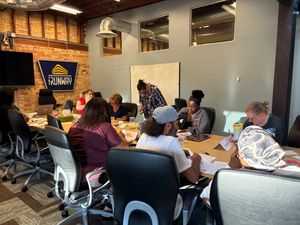
When the day came that I visited the cohort, instead of an activity, we played a game I designed just for them.

"It was such a GREAT activity! I think the participants really enjoyed it. They had fun while learning more about how to actually talk about their business, how to address issues throughout the sales process, and feel more comfortable and confident while doing it. I'd love to do more of this."

Playing the game
In specific, I designed a role playing game where I asked half of the cohort to pretend to be potential customers for the other half of the cohort, who were asked to pitch their real businesses as themselves. We pretended to be at a networking event where locals and entrepreneurs can mingle and see what's going on in town. Players circulated the room and struck up conversations, giving the business owners an opportunity to pitch their business and make some (monopoly) money...with a twist!
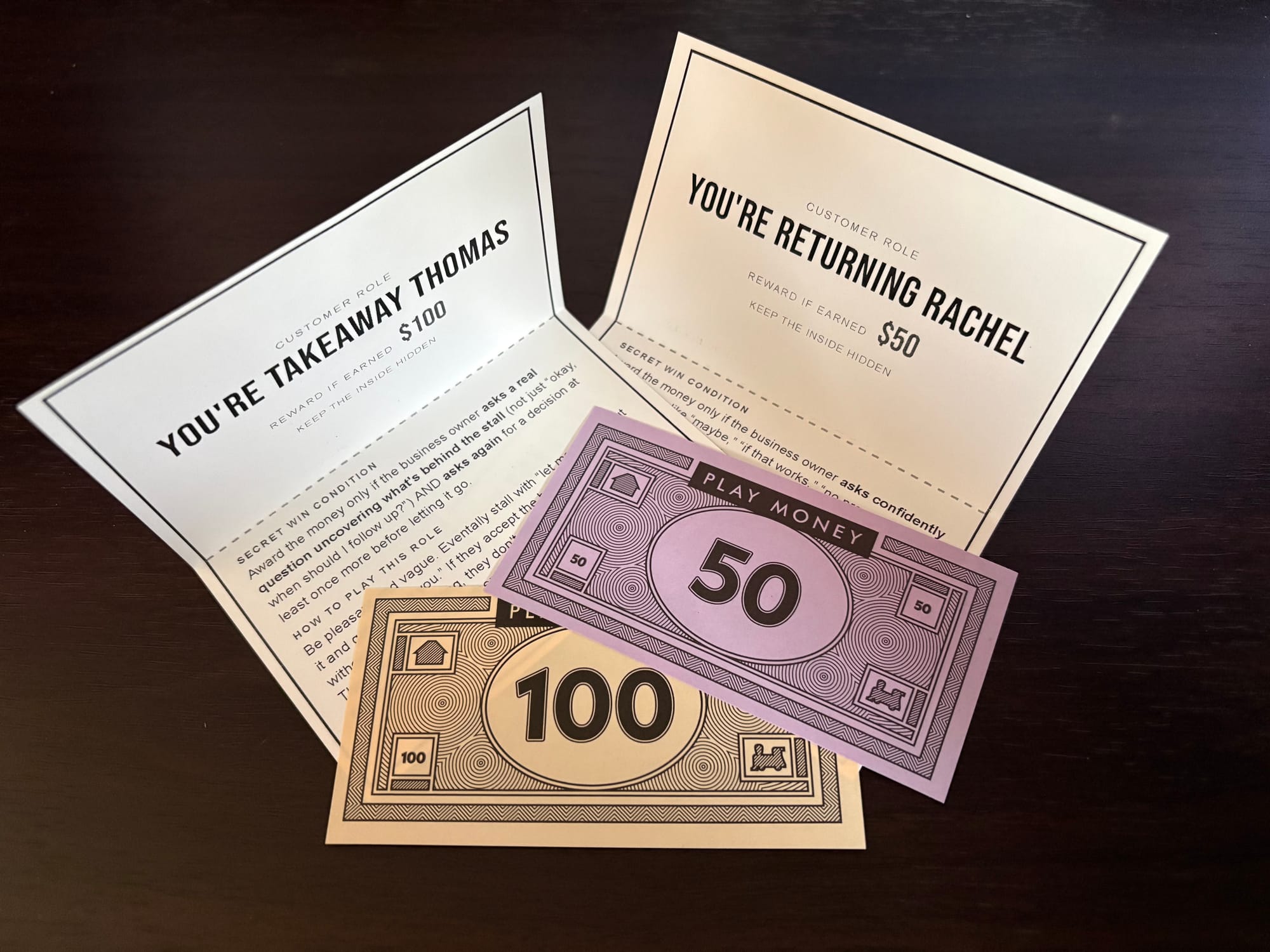
Each potential customer randomly received a card with an assigned name, role, and a secret win condition. For example, one person played as Referral Ruby, an archetype that is a warm lead, who has been recommended this business by a friend. In order to win Ruby's business, the entrepreneur needs to ask Ruby a direct, confident sales question and wait for an answer after speaking, without filling the silence with no pressures or no worries or anything similar. Once the secret condition is met, a reward is given by the potential customer – $25 monopoly bucks.
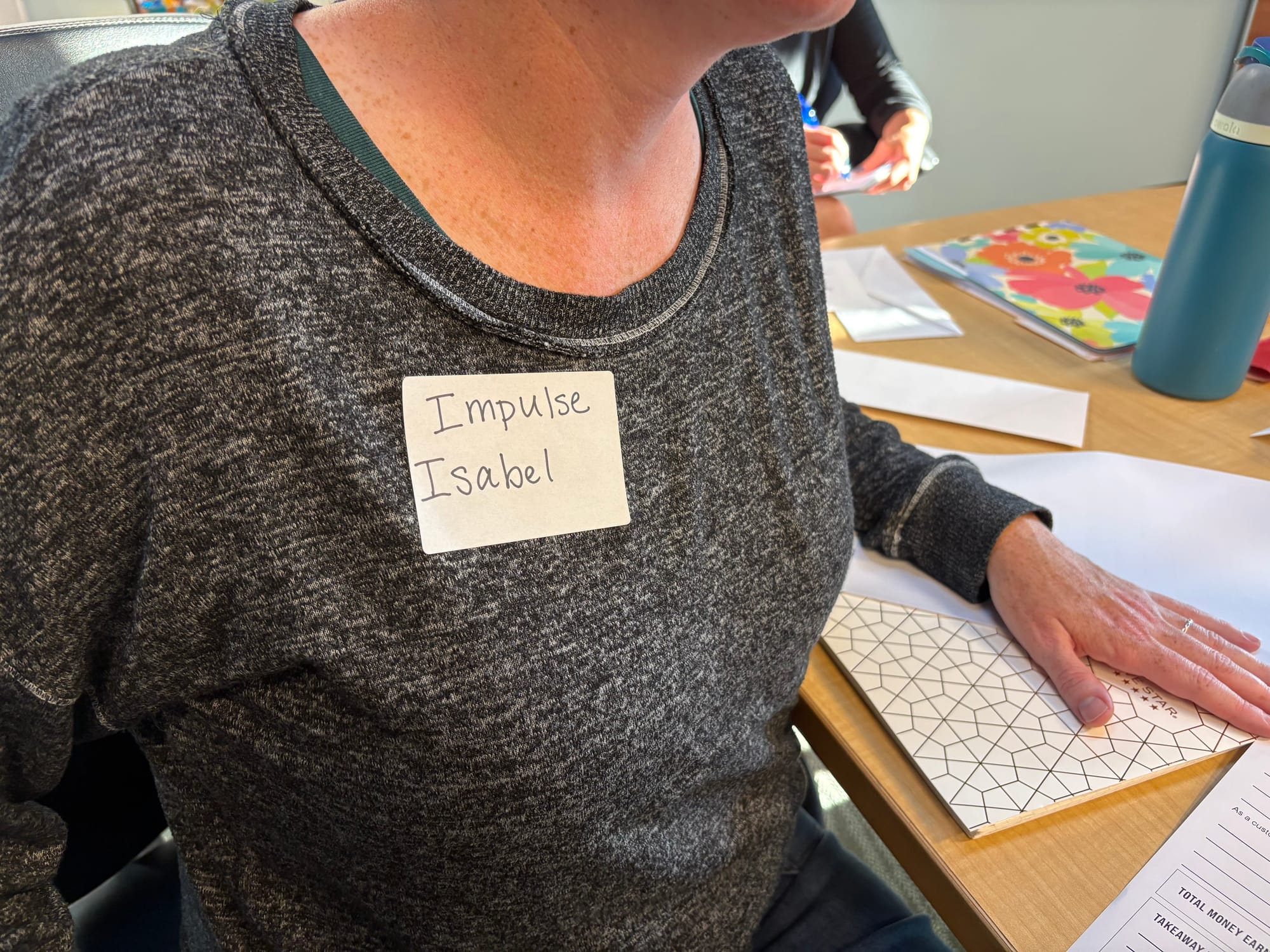
Referral Ruby is one of the easier customers, with no objections, but reward money increases with the complexity of each role's win condition and number of objections. Business owners only have the role names of potential customers to go on, like Ready Freddy and Budget Bobby written on name tags. It's up to them to crack the code through conversation, clues, and questions – much like you would in real life, right?
The hundred dollar question
There was an absolutely amazing point in the game where someone finally got the most difficult customer's business. I created a role named Objection Omar, worth $100, and this customer objects thrice before even considering your offer. Objection Omar first raises a price objection – "That's too much." Then, if you get past that, Omar objects with a "I don't think I have time right now." The final objection hits 'em with a usually-sale-killing "let me think about it."
Funnily enough, the director got this role! I couldn't have been more lucky. She was perfect. Three times I saw Jazmin spin around, reward still in hand, and make a bee line for the next mingle, until one player finally caught the big fish! She was already making her escape when we heard "What do you need to think about?" That was the hundred dollar question. Jazmin and I looked at each other with giddy excitement before she turned around and sat back down and awarded $100 monopoly bucks!
"What do you need to think about?" That was the hundred dollar question.
If your pitches are only about making a sale and completely ignore the person in front of you, you're gonna have a bad time. It's not the potential client's job to be curious about you or your product/service, but it is a business owner's job to be curious about potential clients.
Thinking back to the WWE smackdown level rejection I once received, that person may not have been curious, but neither was I. Had I responded with curiosity that day, I would've learned something to either make the sale or apply to my business.
Any question trying to understand someone's circumstance is a hundred dollar question.
- Why is this out of their price range?
- Why do they need to think about it?
- What do they need to ask their spouse about?
- What made them say no?
In the Apple TV show, Ted Lasso, there's a scene where Ted says "Be curious, not judgemental." At the time, he's in the middle of a game of darts with someone who's underestimated him by not being curious about Ted in the slightest.
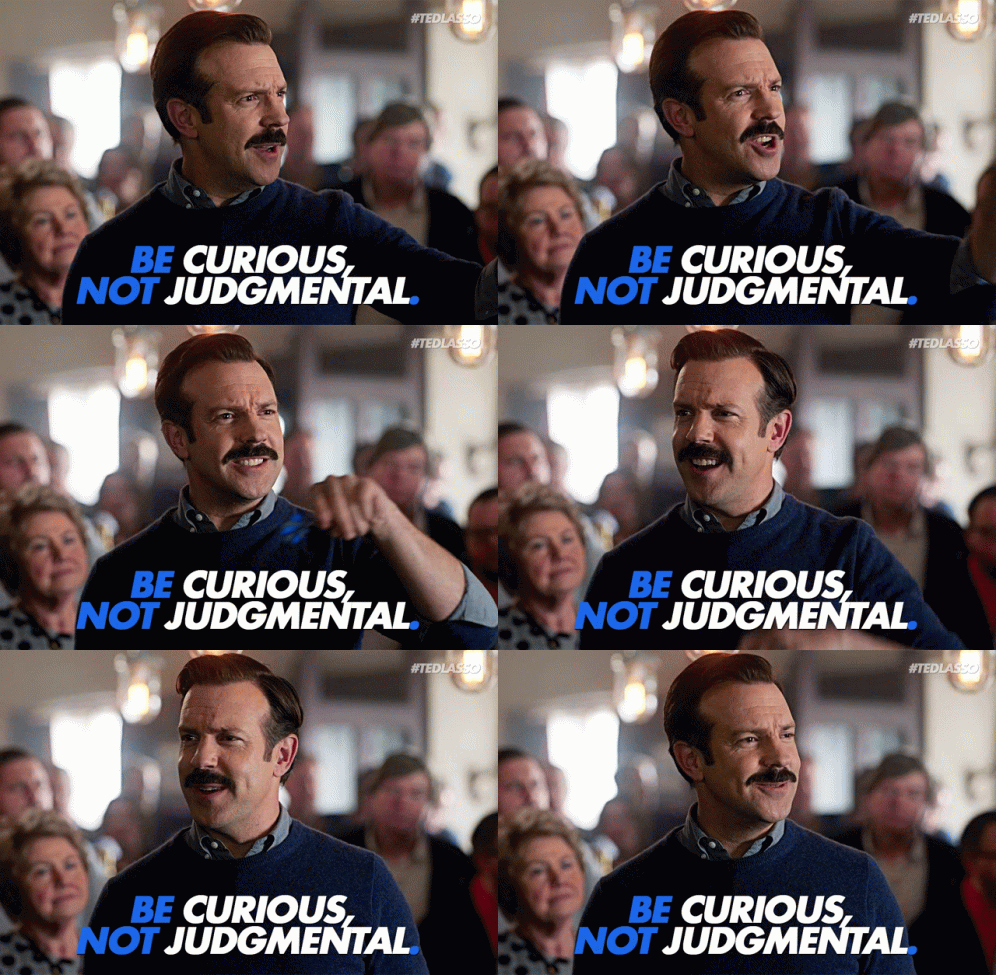
Curiosity leads to empathy, which is essential in understanding potential customers, clients, users – you name it. Empathy and understanding naturally create opportunities to make a sale. Especially in entrepreneurship, it's the difference between throwing services at a potential client and understanding where they're at, what their needs are, and how I may (or may not!) be able to help them.
Even with hundreds of hours conducting user interviews, usability tests, and other research under my belt – methods that require staying curious in difficult situations – it took a while for me to apply this ability to pitching, likely because I was shooketh by my first very big rejection.
That's how I knew this game should target learning outcomes by providing plenty of practice with rejection in its many forms so that when folks in the cohort encounter rejection outside of the classroom, they've already learned to respond with curiosity instead of judgement.
Designing for curiosity
In designing this game, I aimed to give the cohort an opportunity to experience rejection in a safe space, understand why rejections happen, and practice pitching through various levels of discomfort. To make it happen, I focused on creating conditions that encouraged curiosity through the core mechanics of the game.
Asymmetrical information
Only the people playing as potential customers know their role, how to act, and what they can do. Business owners aren't allowed to see any of that information, besides the role name, like Referral Rachel. With only that clue in hand, business owners must be curious in order to figure out how to win a sale.
Trying anything and everything – like immediately offering a discount or going on and on about value prop – instead of seeking to understand the needs of the customer should almost always end in a missed sale.
Rotating roles
Everyone gets a chance to play both roles. As themselves, they get a chance to practice pitching in unique scenarios that mimic pitching to people you meet; introducing yourself, connecting need to opportunity, and making the ask. But! As a potential customer, they can really step into the shoes of someone being pitched to. In this role, players can experience what a buyer is looking for in these types of interactions – what triggers alarm bells, what makes them say yes, or what makes them rethink something. They'll also have to give out rejections, so they'll see that it costs next to nothing to give one, taking away some of its weightiness.
The true magic of this mechanic though is that now the player knows what can be on a role card, so when it's their turn to be business owners again, they'll be more curious about figuring out and nailing those secret win conditions. And now they've seen and felt what curiosity looks like from the buyer's point of view.
Feedback loops
A lot of the time when we discuss feedback loops in games, it's about keeping people hooked. That certainly does happen, but when we zoom out, feedback loops are signals related to actions. You do a thing > Something happens > That impacts what you do next. Feedback loops exist everywhere – in games, psychology, or even your thermostat.
In game design, feedback loops can serve to inform a player's abilities, guide them in a certain way, or turn perceived failure into revised behavior or learning.
For the cohort, I focused on two main feedback loops that encourage curiosity. The first immediate loop is the main gameplay. Players mingle and try to make a sale. When they're met with an objection, they're rewarded if they're curious about the objection and digest what comes from that curiosity into a new ask. Coupled with higher rewards for more complex roles, curiosity is rewarded and brute-forcing a sale is not.
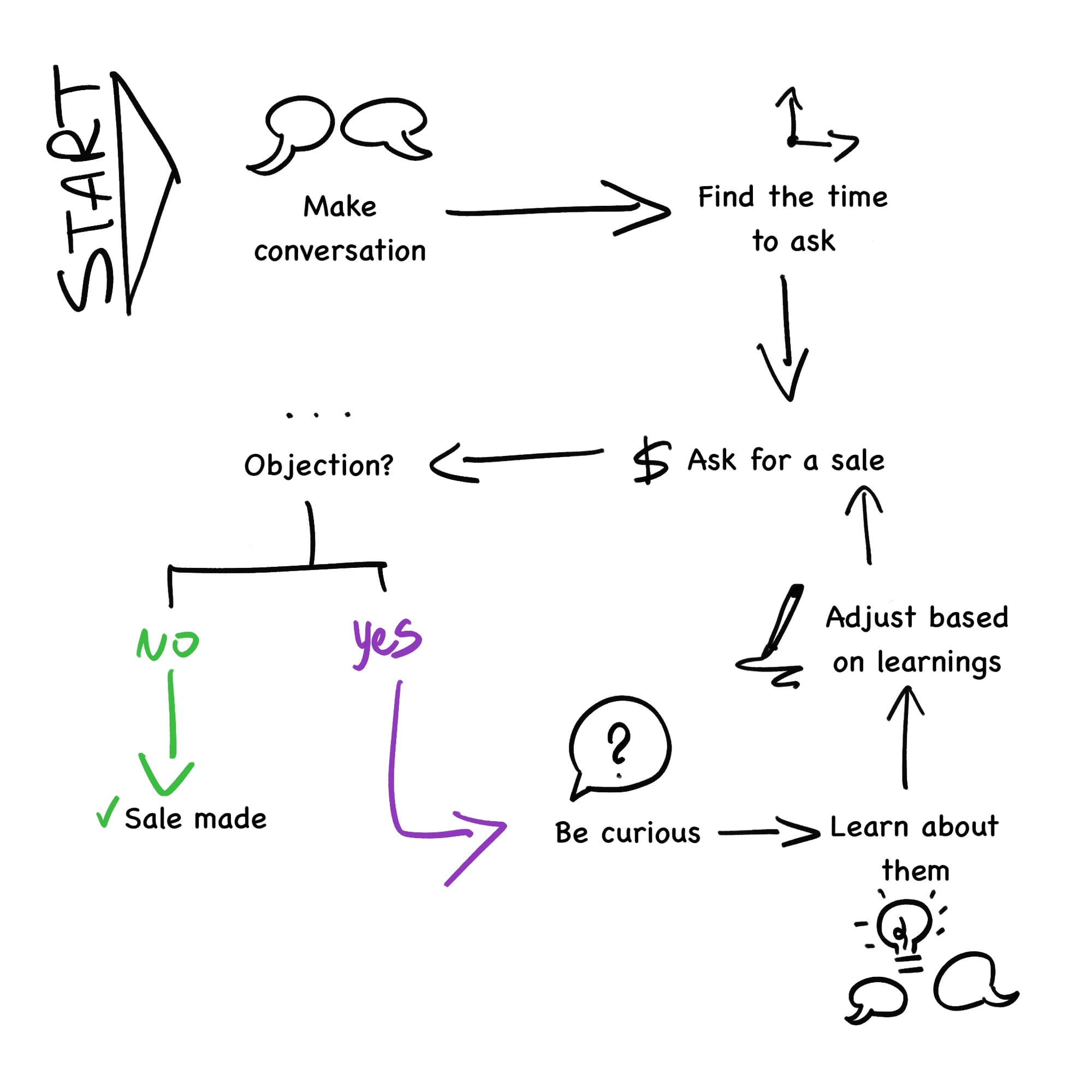
The second feedback loop is more indirect than the first. Playing the game leads to experiences which lead to reflection and then conceptualization, readying the player for their next pitch attempt in the wild.
As part of this feedback loop, after the game, we had a wonderful debrief listening to the players describe what went wrong in some cases and then hearing from the others that got it right. Everyone had a chance to unpack their unique takeaways with the cohort and learn from each other. Jazmin and I led discussions on some of the bigger moments in the game, like the Objection Omar win.
Playing the game has real impact for these entrepreneurs. Even if only half of the cohort manages two more confident, direct asks in a month, at a modest 20% closing rate, for an average sale of $150 — that's ~$420 of projected earnings from just one session. In a year, over $5,000 in revenue! All from one 45 minute game.
Why it works
The cohort willingly walked into discomfort that day. Some people got snubbed while others grappled with wanting to fill uncomfortable silences after an ask. And the shyer folk had to do things they actively avoided in regular life. Why would they let me do this to them?
The game provides a source of enjoyment coupled with learning and practicing in an environment with no real pressure.
That's a lot of words to just say - It was fun! It was fun for them to be different versions of themselves that they haven't yet explored.
Games create experiences, and the brain prioritizes experience over rote memorization. The richer the experience, the better the brain rewires itself to plug in those new learnings. In role-playing games specifically, we can try on different stories and perspectives, without big consequences.
The simple answer says it best though – because it was fun! – and that's what allowed them to see past a scary situation and start making new connections, feelings, and stories around pitching as budding entrepreneurs.

Lissy was the best guest we've had all cohort. I had so much fun doing something I've never done before.
Got a problem you need to solve? Learn more about bespoke game design or my consulting services or jump straight to the fun part - send me a message and let's start thinking!