

What are the chances you've already played a serious game in your life? If you've played a game at school for math, science, or other subjects, that was very likely a serious game! Now, that doesn't mean you liked it...but maybe it holds a special place in your heart anyway. Some started as fully entertainment games and were later used for serious purposes. Either way, I bet you've played at least one of these:
Mavis Beacon Teaches Typing
Welcome to typing class! Can you hear Mavis Beacon saying that in your head? Mavis Beacon Teaches Typing is a suite of games to make learning how to type fun. It included playful activities to improve typing accuracy and rhythm, and lot of people reflect fondly on their adventures with Mavis. A modern version of this game exists today on the Steam platform.
Did you play this one? This isn't my childhood typing game though...
The Typing of the Dead
Here's the game that refined my self-taught typing skills! And started a completely new genre of games. The fun aspect in this game is off the charts, as the entire world is based off the popular original game arcade series The House of the Dead, with the added mechanic of typing in order to shoot.
Designed for entertainment, this game broke out of serious game containment and into the mainstream, becoming one of the best known educational games of the late 90s and early aughts. Many played this game just for fun, with no intent to practice typing skills. When learning and development in games fly under the radar like this, it's considered stealth learning, a very difficult to create and usually intentional outcome in game design.
The Oregon Trail
You've died of dysentery. Am I giving you flashbacks yet? Created in 1971 by three student teachers, The Oregon Trail was intended to teach the dark history around westward expansion from the perspective of settlers. It draws from historical diaries and records as the basis of probability for the events that occur in game, like broken wagon wheels and illness. Your choices affect what happens.
This was the computer lab game of the 80s and 90s. I remember having a good laugh with friends over the difficulty of this game and the dialogue.
If you've been so unlucky as to never have had a chance to play this historical wonder on its original floppy disk, The Oregon Trail is available digitally on the Nintendo Switch! And it's also a card game now!
Monopoly
A game that requires very little introduction, Monopoly has been a household name since the 90s, but most people wouldn't consider Monopoly a serious game. It's really the history and intention behind Monopoly that lands it in the serious games category.
In 1903, Lizzie Magie designed The Landlord's Game, with the intent to teach players about the pitfalls of monopolies. Her game had two separate games modes, each with their one set of rules: 1. in which all players gained whenever wealth was created, and 2. the version we know today about crushing your opponents through real estate and creating piles of cash money.
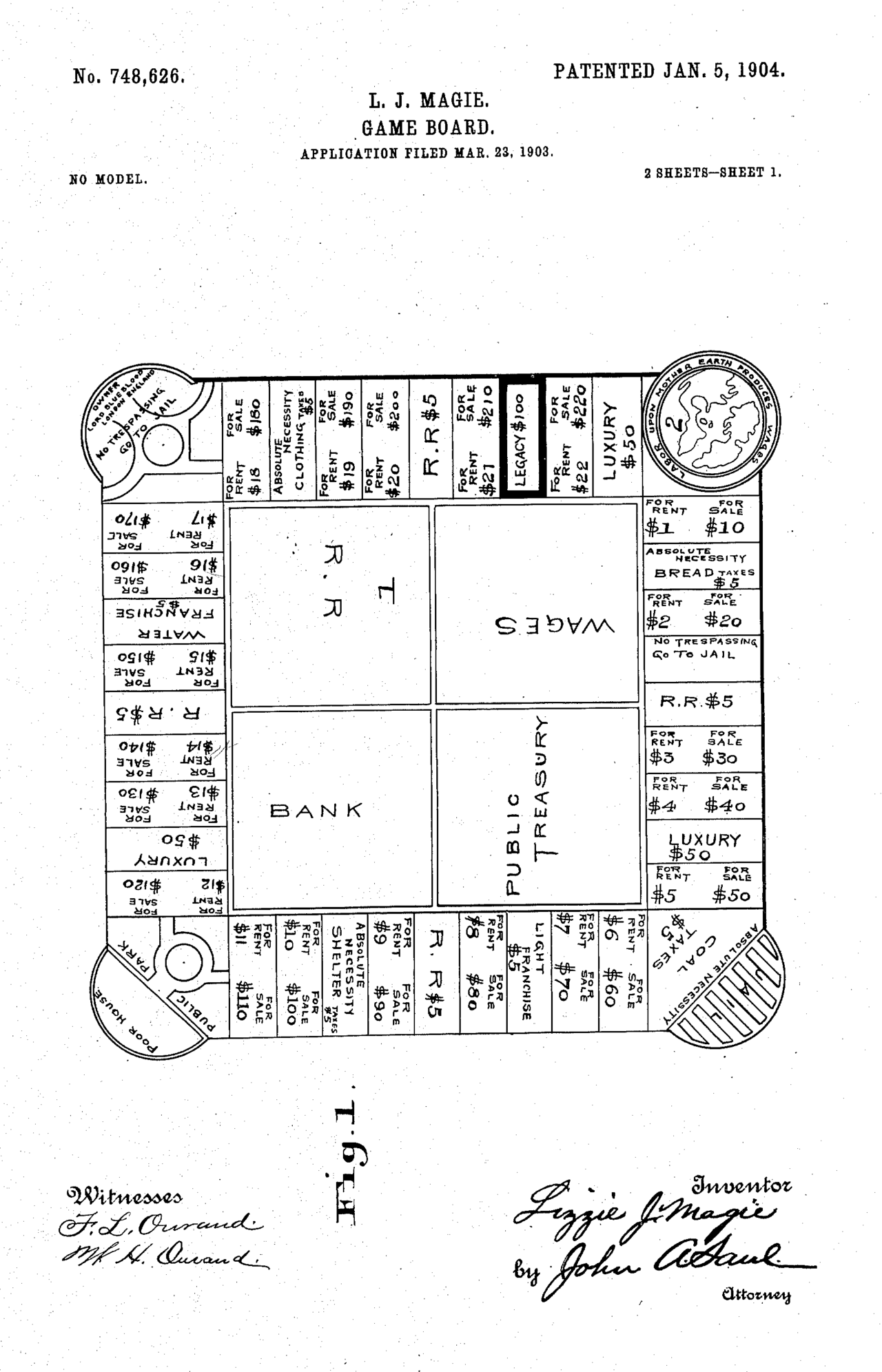
Over three decades, this game took on a life of its own, with different audiences coming up with their own versions, much like families today may remember having their own house rules.
In an incredibly ironic twist of fate, some rando, Charles Darrow, played one such homebrew version of The Landlord's Game decades later and decided to create a nearly identical version with only the Monopoly rules. This is the version that went on to make Parker Brothers mad cash and continues to haunt most of us today.
Monopoly may be one of the first documented serious games, illustrating through its difficult mechanics the social and moral tensions that arise when most of the money falls into the hands of one or two entities. It's a hard lesson to learn which has lead to many tantrums, tears shed, and even moral failures (AKA the person playing banker is always tempted to cheat, right...?).
Learning from serious games of the past
Mavis Beacon is all about making something mundane, like typing, a playful practice. The Oregon Trail gameplay loop is about surviving even after mistakes. Many of us remember these games for the skills and memories we unknowingly took away from our time playing.
The time we spent with these games in computer lab was short but each session stacked our skills. You can use the same approach for play at work.
Find something your team could use some practice with – communication, collaboration, public speaking, sharing ideas – and come up with a small 5 minute way for your team to build that skill, every day or once a week at the beginning of a meeting or at a stand-up.
What makes these little practices work?
They're the opposite of long, boring, dry training and workshops:
- Keep it short, replayable, social, and fun
- Ask yourself what would make it memorable long after you've stopped practicing
- Make participation optional and add other ways to participate, like writing, drawing, pairing up, or observing
- Make mistakes fun and work that failure muscle
- Spend some time discussing and reflecting how it goes. This is how a lot of the learning really sticks.
Not everyone loved the Oregon Trail, but it really stuck to those who played it! Just a little play at work can go a long way, too.