

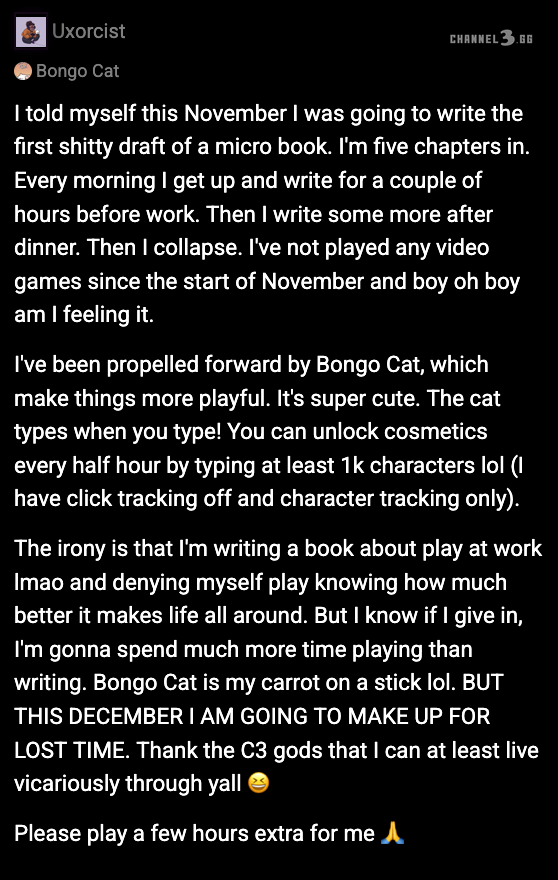
This month, I've challenged myself to write the shitty first draft of a microbook*. It's been a lot harder than I expected, and I made it a lot harder on myself than I needed to. At one point, I posted on my favorite gaming community, C3**, I guess in an attempt to seek comfort from fellow souls on a similar quest of persistence?
I kid you not, no more than two days after posting this, I posted again, this time to basically say I broke my streak and woooow, what was I thinking!
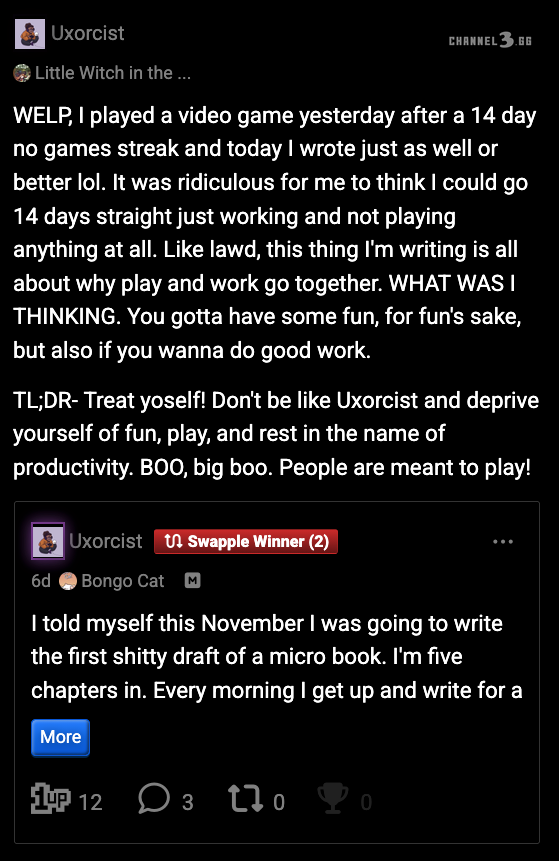
Now Nov 19, I've gone from five chapters to nine. I wrote nearly twice as much in the days following just a couple hours of gaming as I had in the first 14 days of November.
So I took some time to reckon with this personal lapse in judgement.
Why this matters
All right, so we know this wasn't my smartest move ever, but what does my apparent failure have to do with you and play at work?
We know full well that being sleep deprived is harmful to our health, but many adults these days are also walking around with a play deficit, too. A term described by Dr. Stuart Brown in his book Play, a play deficit occurs when playful experiences are absent. People suffering from a play deficit become less optimistic, less sociable, less empathetic, and rigid in their thinking. The longer it goes, the higher the chance to experience depressive states.
If play deficits are so harmful, why do we work against play?
Productivity Culture
You probably know by now that our cultural focus on productivity at all costs is bad. Society rewards productivity and we even use it to measure the value of a person. Ugh. The more I think about it, the more grossed out I get. Even if you agree with these statements, it is still incredibly difficult to get out of this productivity mindset, even when no one is watching. It's incredibly ingrained in us by this point, for any working adult.
If you want to do something well, it's all or nothing. If you want to succeed, you have to put your blinders on and go heads down. If you take a break, that's not productive. Art, eating, walking, TV, friends – unproductive activity. The only worthy activity is the one that provides value.
It's this type of thinking that created the chain of events leading to my productivity "failure," eventually needing to give in to play. Play and productivity aren't opposites. Play helps us rest, recharge, take a break, and open our minds to new possibilities.
Knowing this doesn't it make it easy to play though, but your body is trying to tell you.
See the signals
Before I gave in, I noticed that:
- Work was getting less and less fun and fulfilling
- I had difficulty focusing
- Tasks felt harder
- I felt perpetually exhausted, no matter how many hours of sleep I got
Hindsight is 20/20 amirite? If you notice these in yourself or on your team, it's a signal that it's time to try some play, not to try pushing harder.
Even though I knew all about what I've written here, I still fucked up***. It's incredibly easy to get pulled back into productivity machine mode. For some of us though, crunch mode at work is inevitable. If that's the case, protect your play time as much as your protect work life balance and sleep routines. Pencil it in!
What counts as play?
We've been talking about prototyping a game to play with your team which certainly counts, but that's a big lift, huh? Play can be simple – wiggling to music together or independently, coming up with a hand shake or secret signal, sharing jokes, or using silly voices for a minute. Some people love sports. I'm inclined to play video games! But play potential is everywhere and in everything.
More specific ideas:
- Reset with your team by counting to 20 together.
- Play Spot the Difference with your remote team – ask for a volunteer to share their video, show their room for one minute, then turn camera off. They move something in their background, turn the camera back on, and ask the team to figure out what changed or disappeared.
- Go on a restful color walk and assign each person a color to collect using their phone cameras.
- If puzzles are your thing, try getting a little energy back playing Bracket City or NYT Connections.
It's embarrassing that I gave up play to try to write a book on play. Insert face palm here. Learn from my mistakes!
Ask yourself from time to time what I had to ask myself:
*I learned about microbooks from Vicky Quinn Fraser's own microbook, Don't Eat the Frog, on productivity for people with ADHD (& other brain bees, as Vicky says).
**Channel 3 (C3) is a social media site to connect with others over entertainment media, mostly focused on gaming, but also including books, movies, and TV. Feel free to connect with me on there! It's a small community feel and quite a few connections I've made have turned into IRL friendships.
***Strong language, I know, but I've got strong feelings on productivity culture